

Stop Saying AI is "Intelligent"—You’re Falling for the Hype
"UN Advisor Virginia Dignum on why AI is an extension of human skill—not a replacement for it—and how to reclaim our agency from the Big Tech narrative."

In the latest episode of Voice of Experts, I sat down with Virginia Dignum, Professor of Responsible AI, Director of the AI Policy Lab, and a member of the United Nations Advisory Board for AI. With a career in AI spanning back to 1986, Dignum offers a perspective that cuts through the modern “hype and fear” cycle.
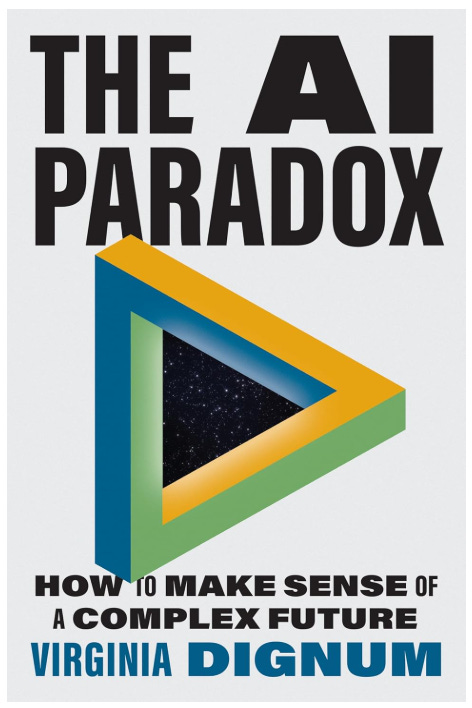
Her new book, The AI Paradox: How to Make Sense of a Complex Future (Get it on Amazon), serves as the foundation for a vital conversation: AI is not an autonomous force happening to us; it is a series of human choices that we must make with intention.
AI as an Extension, Not a Replacement
Dignum challenges the common narrative that AI is a competitor to human intelligence. She suggests we view AI similarly to other tools we’ve built to surpass our own physical limitations:
The Car Analogy: Just as it would be “idiotic” to compare a human’s running speed to a car’s speed, it is strange to compare human arithmetic to a calculator. We build systems to excel at specific tasks, but they do not replace the human core.
Irreplaceable Human Qualities: Creativity, empathy, and social/emotional intelligence remain inherently human. AI should be seen as an extension of our skills in decision-making and pattern identification, not as a replacement.
The Fairness Paradox: Fairness is Not Justice
A central theme of the discussion was the limitation of “algorithmic fairness”.
Mathematics vs. Social Contracts: While mathematical fairness can be solved with equations, true social justice is a complex social contract.
Data is a Construction: Data is not an objective reality but a human-constructed “choice” of what to collect and how to label it. Therefore, AI only distinguishes what humans make it possible to distinguish.
Challenging the “Big Tech” Narrative

Dignum warns against the “monolithic” view of AI pushed by major corporations—the idea that “more data equals better systems”.
Concentration of Power: The massive computational power required for today’s LLMs concentrates power in very few hands.
The AGI “God” Narrative: Dignum argues we should stop obsessing over building a “god-like” Artificial General Intelligence (AGI) to solve our problems and instead focus on collective intelligence—leveraging diverse human capabilities through technology.
The Environmental Cost: We must balance the claim that AI will “save the planet” against the massive environmental footprint of data centers. Dignum suggests we need to start asking when to forget or delete data rather than defaulting to building larger infrastructures.
A “Questions First” Approach to Policy
For governments and organizations, Dignum advocates moving away from the “Fear of Missing Out” (FOMO) that leads to an “AI-first” mentality. Instead, she proposes a “Questions First” approach:
Why is this AI system needed?
Who benefits from it?
What are the alternatives?
What is lost by implementing it this way?
Education Over Restriction

Addressing the impact on youth, Dignum shared insights from her work with UNICEF.
Awareness in Youth: Students as young as 12–15 are already aware that AI can make them “lazy” by doing their homework, which they recognize as a loss of learning.
Literacy is Key: Rather than outright prohibition, Dignum advocates for comprehensive AI literacy—training both youth and adults on how to use these tools responsibly and understanding their inherent limitations.
The Path Forward: Local and Transformative
Real transformation, according to Dignum, doesn’t come from generalized chatbots but from localized, targeted systems. She highlighted examples like mobile tools in Africa for detecting cervical cancer and systems in Northern Sweden that help indigenous populations combine traditional knowledge with climate data for reindeer management.
My takeaway: Responsibility isn’t a hurdle to innovation; it is the path to it. As we move forward, the question isn’t just what AI can do, but what it should do for our collective future.
🔗 Links & Resources
Read Virginia’s Book: https://a.co/d/0fXZROeZ
Follow Virginia Dignum on LinkedIn: https://www.linkedin.com/in/vdignum/
Subscribe for more expert insights: https://www.voiceofexperts.com/