


I sat across from Ricardo Rocha recently, and it was one of those conversations that could have lasted for hours. He is currently the Global Head of Marketing at Noesis, a technology company with more than 1,000 specialists all over the globe.
Ricardo deliberately stepped out of the marketing track to take a sales director role before returning to global operations with a PNL mindset. That single, uncomfortable detour changes absolutely everything about how a person views a pipeline.
Basically, without that exposure, marketing departments default to creating pretty campaigns and chasing vanity metrics. They obsess over visuals. They forget the revenue. Because experiencing direct customer objections and facing raw commercial pressure every single day forces a professional to abandon comfortable theories, stop obsessing over visual aesthetics, and instead build conversations that generate actual, measurable revenue. It was incredibly refreshing to hear an executive admit this right off the bat.
“The American enterprise sector is a completely different beast” - Ricardo moved to the US in 2022 to direct their expansion, quickly realizing that European credibility simply does not cross the Atlantic. Back in Portugal, Noesis works with almost every major company on the stock index.
They can confidently offer a massive menu of services, spanning everything from cybersecurity protocols to complex cloud architecture, which allows them to grow accounts gradually over years of built trust. But in America, showing up as a generalized IT firm instantly kills your credibility. The scale is wildly different; a midsize company in Florida might generate more revenue than a flagship enterprise in Lisbon. You cannot just walk in, open your jacket, and offer to do everything.
You must find a very sharp wedge.
Most American companies, according to his experience, have zero patience for grand, theoretical roadmaps. They are execution-focused and intensely practical. They want a highly specific problem solved immediately. If you fail to execute on that single piece, the partnership is terminated on the spot. No second chances. It forces you to abandon the comfort of selling a broad transformation and instead prove your worth on one tiny axis.
The conversation kept flowing and naturally took us to artificial intelligence. Every executive I speak with claims their organization is undergoing a massive AI transformation. Ricardo called this out for what it actually is: basic productivity adoption. Handing your team generative AI tools to summarize afternoon meetings or draft emails is not a transformation. It just makes the old, outdated system run slightly faster. True evolution only happens when the technology forces a fundamental redesign of your underlying business processes.
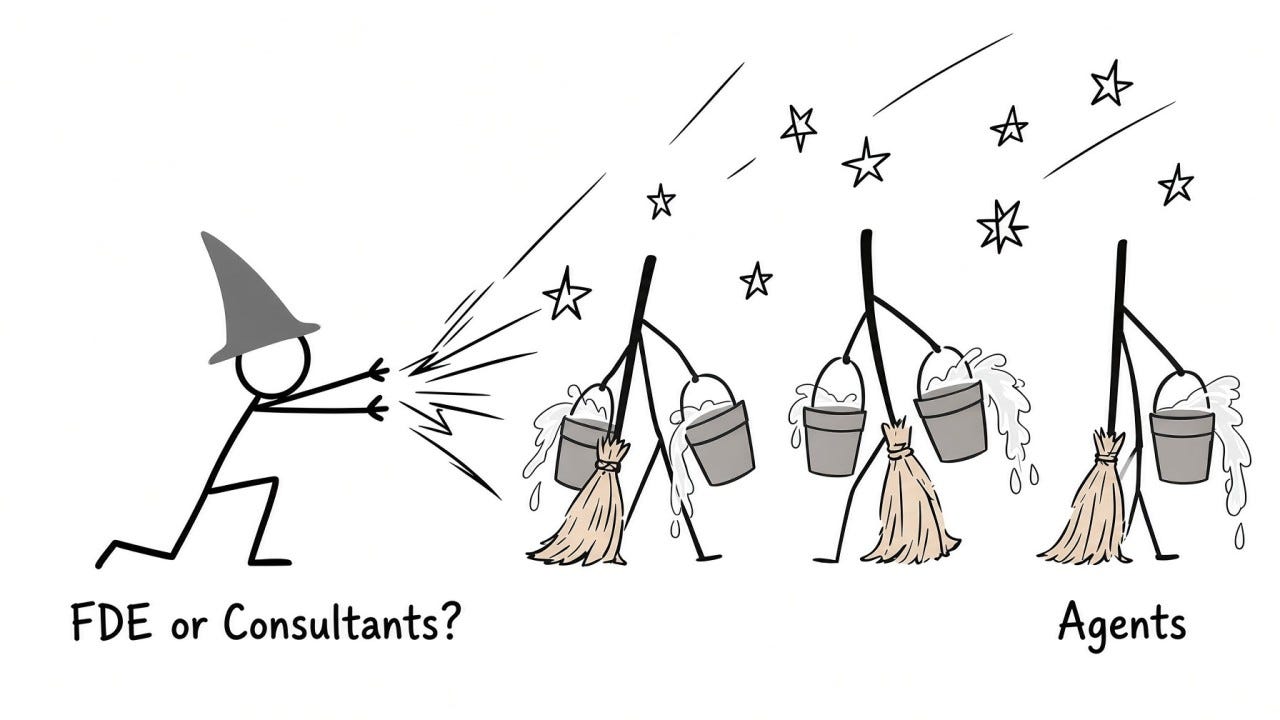
The traditional consultancy model has survived for decades by billing hourly rates for human labor. Agentic systems destroy that math completely. When a machine executes the labor in a fraction of the time, billing clients by the hour becomes utterly illogical.
Pricing models have to shift entirely toward the value of the outcome. The firms that survive this shift will be the ones that stop selling their time and start selling guaranteed results.
Bottom line, our conversation left me staring at my own whiteboard later that afternoon, rethinking how we structure operations at Codedesign. The market demands hyper-specific execution.
This experience is very similar to Codedesign. Although we’ve been successfully working with American clients, we understand the nuances of the culture and how having a physical presence has been a crucial part of our success.
You either deliver it, or someone else will take your seat at the table.